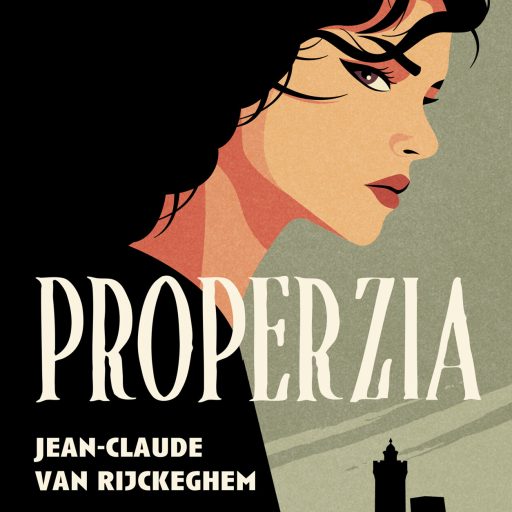
My latest novel came out in October 2025 and is called Properzia. No English edition is planned as I write this but an excerpt in English can be found on the Flanders Literature site.
I discovered Properzia De’ Rossi by chance while reading an article about woman artists in the sixteenth century. Properzia lived between 1490 and 1530 in Bologna, in northern Italy, and is considered the first female sculptor of the Italian Renaissance. Not much is known about her life and work. Nor is there any portrait made during her lifetime. For a historian, that can be frustrating, but for a storyteller, it actually creates opportunities.
Three years ago, I knew almost nothing about the Italian Renaissance, apart from what I had once read in the enjoyable adventure novel ‘The Medici’s Guns’ by the British author Martin Woodhouse, in which none other than Leonardo da Vinci is the hero. He casts cannons, strolls with noble ladies along the banks of the Arno, paints a small portrait, and also saves the Medici’s fortune – but only just. So I certainly had some catching up to do on the Renaissance.
The term ‘Renaissance’ or ‘rebirth’ only came into vogue during the nineteenth century and owes much to the Florentine artist and historian Giorgio Vasari, who wrote the book Vite (Lives) about Italian artists of the 15th and 16th centuries. He planted the seed for the idea that the arts, which had fallen into decline after the fall of the Roman Empire, were being reborn in his time. The book features a short chapter on Properzia De’ Rossi, which means that she must have been well known and admired in her time.
When I began researching the Renaissance three years ago, I was surprised to discover just how miserable the sixteenth century actually was. Italy was a patchwork of small states that were constantly at war with one another and waged campaigns with armies of mercenaries from all over Europe. The cities were dirty, dusty and overcrowded. The countryside was unsafe. The gap between rich and poor was unbridgeably wide. Social mobility was non-existent. There was no cure for infectious diseases such as the plague, typhus, malaria and syphilis. People would rather say one Hail Mary too many before stepping out the door. And then there were the patrons, the people who commissioned artists! They were dishonest bankers who had amassed great wealth, murderous mercenary generals who had themselves called ‘knight’ or ‘duke’, and popes who were not too strict about the Ten Commandments. The Renaissance, with its fanaticism and intolerance, is actually a dark stain on history. It is therefore almost unbelievable that in such a world, paintings, frescoes and sculptures were created that still live on in our time. Perhaps it was precisely the ugly reality that spurred the artists to carve beauty out of stone, to paint an ideal on canvas, to create something that existed only in their imagination.
And Properzia de’ Rossi was one of the first female artists of that Italian Renaissance.
The few women who practised painting in the sixteenth century had grown up in their father’s studio amidst the brushes and linen canvases. But Properzia’s father was no artist. He was a notary, and that used to be a suspicious profession. The medieval writer Giovanni Boccaccio mercilessly mocks notaries in his collection of stories, the Decameron. A notary, he writes, was a man ‘who would cheat you with the clear conscience of a saint’. According to an old Italian saying, a notary was ‘one of the nine things that would bring about the end of the world’.
We know that Properzia, the notary’s daughter, became a sculptor because her name appears in the accounts of the Basilica of San Petronio. She was paid for creating angels and soothsayers, and for two marble panels on the façade of the enormous church. But those accounts were vague: angel, so many lire, panel, so many lire… And Properzia’s name is not engraved on the works she created.
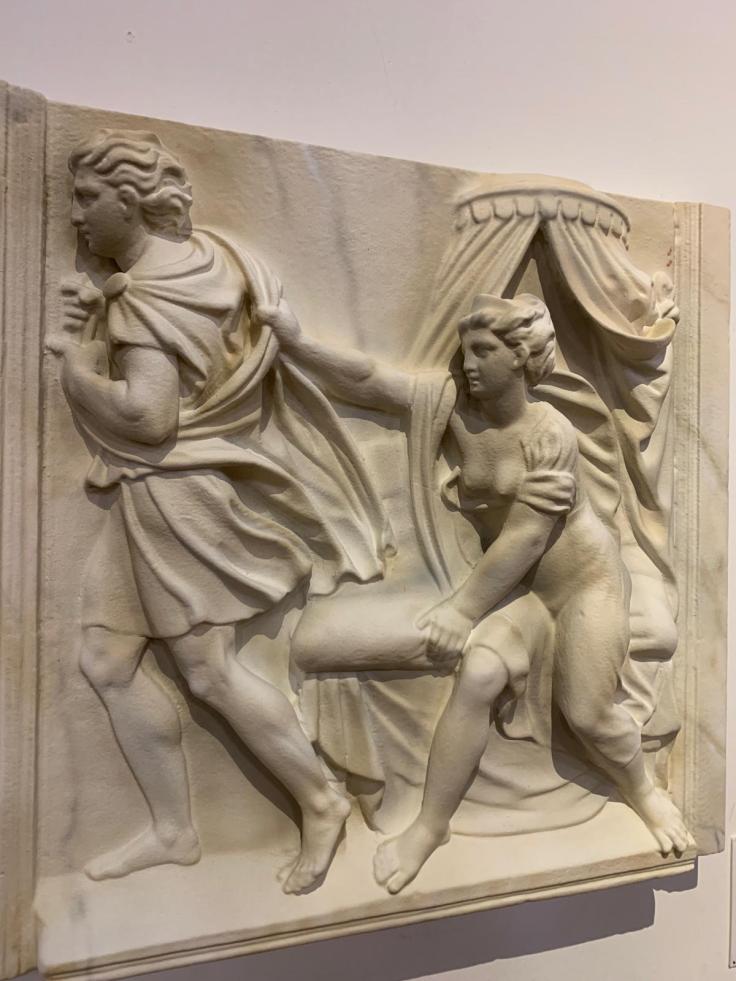
There is only one sculpture that can be attributed to her with certainty, because Vasari wrote about it in his book. Her panel depicts a scene from the Old Testament: ‘Joseph being tempted by Potiphar’s wife’. And the panel does not focus on the virtuous Joseph, tested by God, but rather on ‘the woman’.
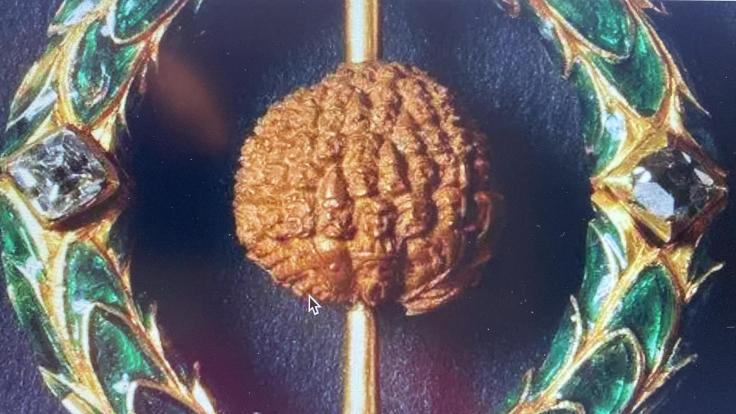
Vasari also wrote that Properzia was admired in her day for carving scenes into the pits of fruit. For example, there is a cherry pit with a hundred faces carved into it that is attributed to her. Vasari also claimed that she was a ‘poor woman who was consumed by heartbreak’. Today, this is taken with a pinch of salt. Vasari had never met her, and an art historian in the sixteenth century was, in every sense, a storyteller.
Below is the incredibly small cherry stone with a hundred faces. The work is on display at the Pitti Palace in Florence.
Properzia is mentioned not only in the church accounts but also in the Bologna criminal court records: she had to appear in court for the first time following a neighborhood dispute that had gotten rather out of hand, and a second time because she had verbally abused a fellow painter in the street and scratched his face ‘until the man started bleeding profusely’… these are, of course, the sort of details that make my storyteller’s heart beat faster.
I could already picture Properzia, berating fellow painters and strolling along the ancient Roman road, the Via Flaminia, which connects Bologna with Rome. I could picture her already in the Eternal City, where she revelled in the images from antiquity and descended into the newly discovered underground palace of Emperor Nero, where, a few years earlier, artists such as Ghirlandaio, Raphael and Michelangelo had, by torchlight and perhaps for the first time, seen intact frescoes from ancient Rome. A story began to take shape in my mind and I immediately put a few chapters down on paper of which I was a secretly proud.
But I thought: I’d better consult an expert. I travelled to Bologna and made an appointment with Professor of Art History Irene Graziani because she had written essays on Properzia. In her office, in the Faculty of Art History of the centuries old Bologna university, I pitched somewhat clumsily the story I was going to tell: the fellow painters, the journey to Rome… descending into palaces… torches… Professor Graziani looked at me with growing astonishment and then said that Properzia had spent her entire life in Bologna. Or at least somewhere near Bologna. She had never been to Rome. There was no evidence whatsoever of that.’
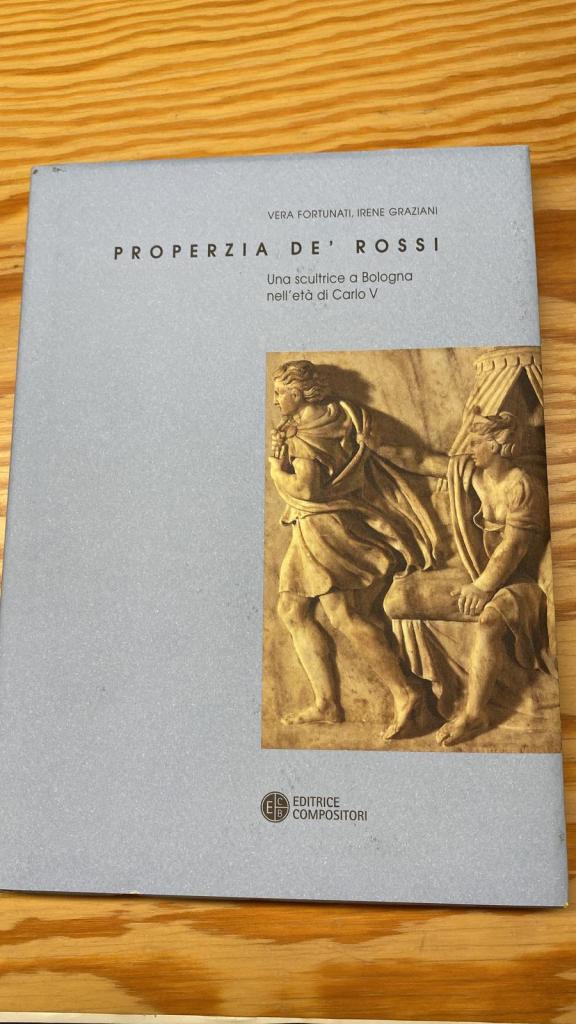
(Irene Graziani and Vera Fortunati’s collected essays on Properzia De’ Rossi)
I asked then, ‘Are you sure about that?’, because in my imagination she had, of course, done all of that.
Well, there went my vivid chapters. My story had fallen flat before it was even properly written.
I must have looked a bit disappointed at the art history department, because Professor Graziani said: ‘But, young man (sic.), surely you know who was in Bologna when Properzia was about fifteen?’
No.
She told me that Pope Julius II, nicknamed ‘the Terrible’, Il Terribile, had taken Bologna in 1506 with an army of ten thousand mercenaries and had summoned an artist to the city to create a huge bronze statue of him.
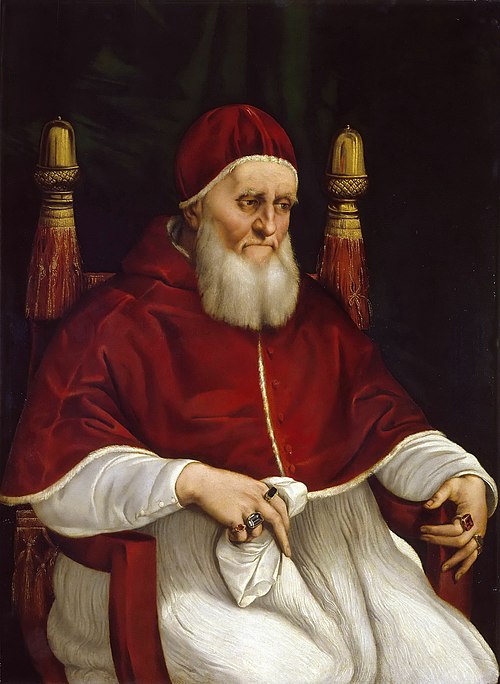
(Julius II, painted by Raphael in 1512)
The artist was Michelangelo. He was 35 at the time, and his statue of ‘David’ had already been on display in front of Florence’s town hall for two years. Irene Graziani explained that it is highly likely that Properzia met Michelangelo when she was a young woman of 15 or 16, not least because his influence is evident in Properzia’s only work known with certainty. In her panel, the female figure has the muscular arms so typical of Michelangelo’s sculptures.
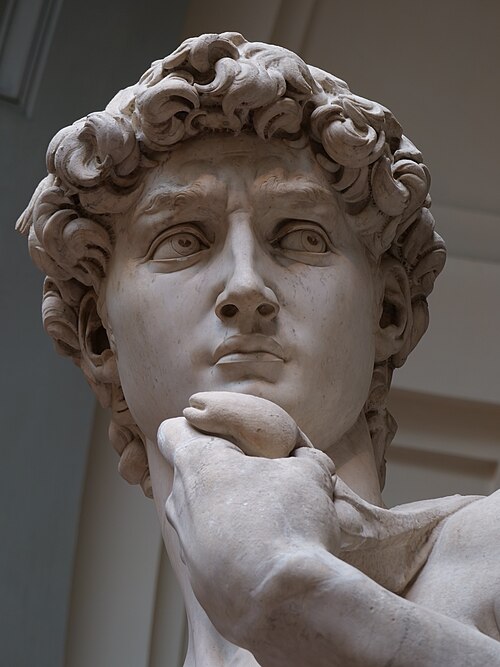
(A detail from Michelangelo’s ‘David’. )
That visit to Bologna, that meeting with Irene Graziani three years ago, set me on the right path to tell this story.
In my book, Michelangelo and Julius II play only minor parts. My main character is a young woman who, between the ages of fifteen and seventeen, defied prejudice, expectations and warnings, decided to become something that did not yet exist: a woman sculptor. The art of sculpting was deemed unsuitable for women due to their ‘delicate consitution and slender wrists’ as Vasari puts it.
During my visits to Bologna, I spoke to Professor Graziani three times and asked her many stupid, clumsy and often repetitive questions in my broken Italian, and she gave me lots of insights into Bologna’s past. She often spoke of ‘our Properzia’ as if the sculptor were a distant relative of hers. I asked her what she herself thought about Properzia’s life… her life of which we know so little. She fell silent for a moment… and then she said it must have been very hard. Opponents, financial problems, run-ins with the law, illness… a difficult life.
But Properzia became everything she wanted to be, a sculptor, and I have tried to tell her story.

