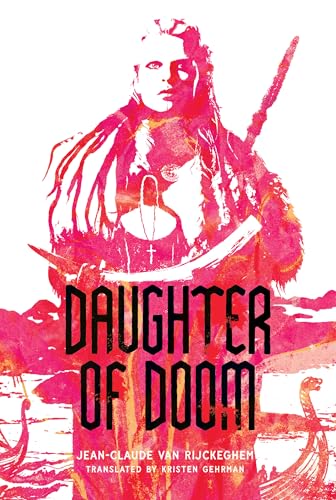
Denmark, AD 870. Yrsa knows her place in the village of Mimir’s Stool. Though she was born with a crooked foot, she’s never let anyone underestimate her; after all, she’s the daughter of Toke the helmsman and granddaughter of the fearsome warrior Gudrun the Torch (who, according to legend, stood before the walls of Paris, splattered in the blood of Frankish warriors). And no one else in the village shares her ability to see what the Norns, the three weavers who live under the roots of Yggdrasil, the world tree, and craft people’s fates, have in store for them.
One day the men return from a raid with a high-ranking hostage, Sister Job, and though the two girls couldn’t be more different, they look out for one another. And when one of the villagers viciously assaults Sister Job and she and Yrsa mortally wound him in self-defense, they’re forced to take to the sea to escape the wrath of the warriors of Mimir’s Stool, and worse, the wrath of the gods. Can either of them escape their fate? Do they even want to?
From the acclaimed author of Ironhead, or, Once a Young Lady, comes Daughter of Doom, a dark historical adventure about fate, faith, and free will set on the rollicking seas in the age of Vikings.
The idea behind the book.
There is a story behind each of our names. Our names connect us to the past. My name – Rijkeghem – was originally a place name. Near Tielt in West Flanders, there is still a place called Rijkegemkouter. A kouter – I had to look it up – used to be a cultivated piece of land. My uncle Willy did some research in the archives of the town of Tielt and it turned out that the name Rijkegem or Rikegem already existed in the mid-ninth century and is one of the oldest place names in the region. The name is said to go back to Rikiwulfingaheim, meaning: the dwelling place (the heim) of the people of Rikiwulf.
And Rikiwulf is, in turn, a Danish or Norwegian name and means ‘the Master of the Wolves’. My uncle then had his DNA tested, and our family is said to have originally come from Denmark or Norway.
I’m not one hundred per cent sure if it’s all accurate, but I thought there was a good young adult novel to be had in that ‘Master of the Wolves’ and in that ninth century.
I was once given the advice: write about what you know. But every time I start a historical children’s book, I step into a past about which I know almost nothing. Yet it is precisely the process of discovering, unravelling and trying to understand that distant past – though occasionally frustrating – that is also part of the joy of writing for me. Two archaeologists – Dries Tys in Ghent and Adam Bak in Denmark – have helped me get started and given me lots of tips. In Jelling, Denmark, there is an impressive Viking museum on the site where King Harald Bluetooth had built a longhouse.
The ninth century.
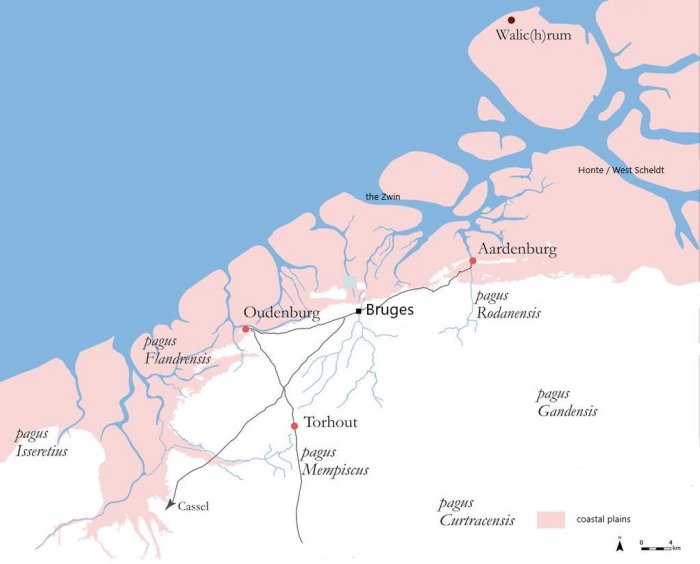
In the ninth century, the world looked different. The Western Scheldt did not yet exist. It was a sandy plain flooded by the tides. The region around Ghent was a marsh and was known – in Latin – as the Pagus Flandrensis, which means ‘the flooded land’. The name Flanders is derived from ‘Flandrensis’. Below is a map showing a reconstruction of our coastline. At the top, on the island of Walcheren, lay Walacrium (or Walicrum), a Viking town (and previously a Roman fort). The place plays an important role in the novel. Today, it is Domburg.
The Danes and Norwegians of the ninth century were presumably called Vikings by the people of the North Sea because they travelled along the ‘vici’, the Latin term for ‘marketplaces’. They visited the markets of the North Sea and must also have settled there. The name Bruges comes from the Danish ‘Bryggja’, meaning ‘bridge’. Le Havre in Normandy comes from the Danish ‘havn’, which of course means harbour, and Dieppe in northern France comes from the Danish ‘diepe’, which refers to the depth of the river that flows into the sea there.
At the North Sea markets, wool, hides and foodstuffs were traded or sold, but people were also traded there. Only very recently have archaeologists begun to realise the scale that this human trafficking must have been on. Every Danish farm had slaves. The Danes had more than ten terms for slaves at the time. A male slave was a ‘thrall’, a female slave an ‘ambatt’, a slave who performed domestic tasks a ‘deigja’, a slave who wove a ‘seta’, and so on. The economy of the Scandinavian peoples in the ninth century – the success of the Viking model, so to speak – was based on the exploitation of slaves.
The myths of the North.
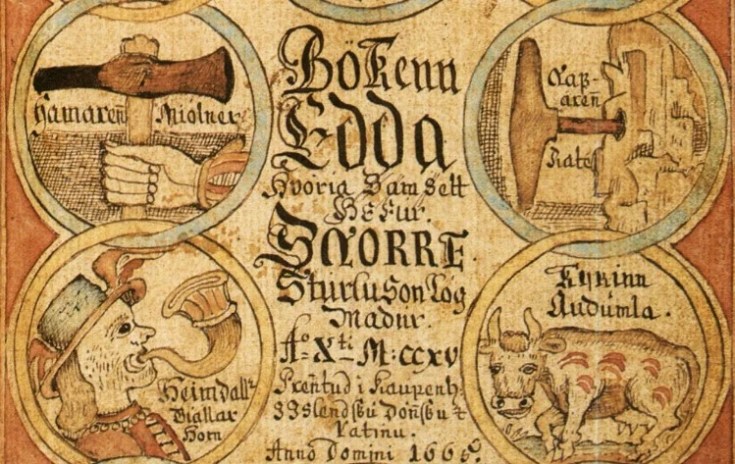
I also learnt about the Danish gods, whose stories were only recorded in the 12th and 13th centuries by the Icelandic monk Snorri Sturluson. His book is called the Edda, which means ‘grandmother’. The myths were passed down orally for centuries, and the man who eventually wrote them down was a monk. His primary concern was, in fact, to preserve Norse and Germanic poetry from oblivion, but he interpreted the myths through a Christian lens, thereby emphasising their pagan or even diabolical nature.
The Danish gods were not all knowing and omnipotent like the Christian God. They often behaved like unruly children and changed gender as easily as changing their clothes. They were gender-fluid. I write ‘Danish’ gods, but that isn’t entirely accurate. They are also the gods of our ancestors.
Archaeologists suspect that the worship of Wodan – the Germanic name for Odin – originated on our side of the North Sea and that the cult reached Denmark via the Germanic tribes. Those ancient gods are still with us, in the days of the week. Tuesday is the day of Tyr, the god who lost his hand in the jaws of a huge wolf. Wednesday is named after Wodan, the father of the gods, and Thursday is the day of Thor, the god of thunder. He was the god who brought good fortune and offered protection, which is why our ancestors preferred to get married on a Thursday. And Friday is the day of Frigg, Wodan’s wife, who weaves the clouds with her spinning wheel.
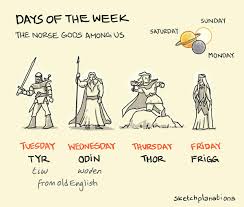
In the later centuries, the rulers of the church attempted to change the names of the days of the week by renaming them as days of well-known saints, such as apostles Peter or Lucas, but the idea never took off. It kind of illustrates how, in later centuries, the old gods were not forgotten. In the eleventh century, the German church authorities did manage to change Wednesday, called ‘Wodanstag’ (day of Wodan/Odin). They changed it into ‘Mittwoch’ (Middle of the Week), a bit of a bland named compared to the mythical day of Wodan.
Odin in women’s clothing.
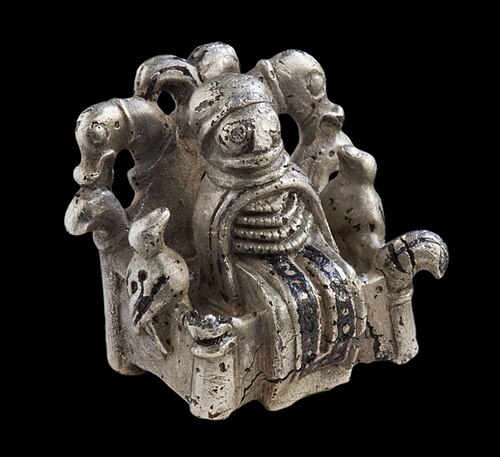
Speaking of Wodan or Odin. Below is a small figurine. It was found in a Danish grave in 2009, is 18 mm high and weighs 9 grams. It dates from the ninth century and depicts a one-eyed figure on a throne with two ravens and two wolves. Most archaeologists agree that the figurine depicts the god Odin, who surveys the nine worlds from his throne, Hliðskjálf. His ravens are called Huginn and Muninn and tell Odin what is happening in the world. The wolves are called Geri and Freki. It is striking that Odin is wearing women’s clothing.
The inner life of the Danes was fascinating. What I found beautiful was that the Danes believed happiness was a person, a sort of shadow walking beside you. We say that happiness can abandon you, and the English say ‘his luck ran out’ – his luck deserted him. These expressions stem from the pagan belief that luck was an independent being that could simply abandon you, perhaps never to return.
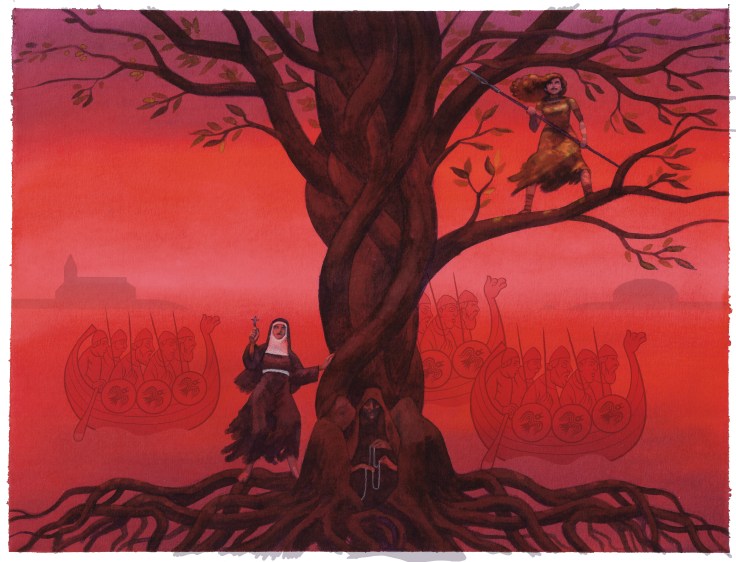
The Danes believed that they also had an inner self, their hugr, but that their outward appearance, their shell, their hamr, was not fixed. A person could change, transform. Not just into a wolf or a seal, but a man could become a woman and vice versa. A person did not decide this for themselves; three old women under a tree did. They wove the fate of every human into a stretched-out woollen cloth, as if life were a pattern in a sail. Everything revolved around the sea.
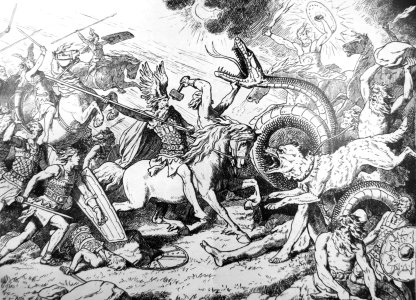
The gods, too, had their fate. Odin was often despondent because he knew how he would meet his end: devoured by the enormous wolf Fenrir on that dreadful last day of the world which the Scandinavians called Ragnarok, literally: the fate of the gods.
But back to my ancestor. When I start writing a novel, I usually do so without a proper plan. I thought the story would be about Rikiwulf, master of the wolves, but when I began this book – two years ago – two young women immediately took over the narrative. I discovered YRSA, a young Danish woman who worships her pagan gods and believes that everything is predestined, that a person’s life is already predetermined because it is woven into a cloth by three old women under a tree. And SISTER JOB suddenly appeared before me too. A Sister from the Convent of Our Lady on Blandijn Hill in Ghent. She is abducted by the Danes but is more fanatical than three popes put together and claims to be the great-granddaughter of Charlemagne.
My ancestor became nothing more than a minor character, and not even a particularly likeable one at that. I can’t help it. As I wrote, I had grown to love Yrsa and Job. DAUGHTER OF DOOM is their story.

The Flemish newspaper ‘De Standaard’ described it as one of the ‘most extraordinary young adult novels of the year‘. It featured on the longlist of the yearly Boon award. It was also well reviewed by Publisher’s Weekly in the US.
Flanders Literature wrote: Daughter of Doom’ is a cinematic adventure novel in which two women hold their own at a time when this was anything but a given. Jean-Claude van Rijckeghem has created two beautiful characters, who are deeply rooted in their respective faiths. Both Yrsa and Job are convinced that fate is unavoidable, each in their own way, and yet they manage to find their own path in life. Van Rijckeghem peppers the story with action and suspense, but never at the expense of depth. The occasional humour is a nice finishing touch. A remarkable book about fate, faith and free will, in vivid language.
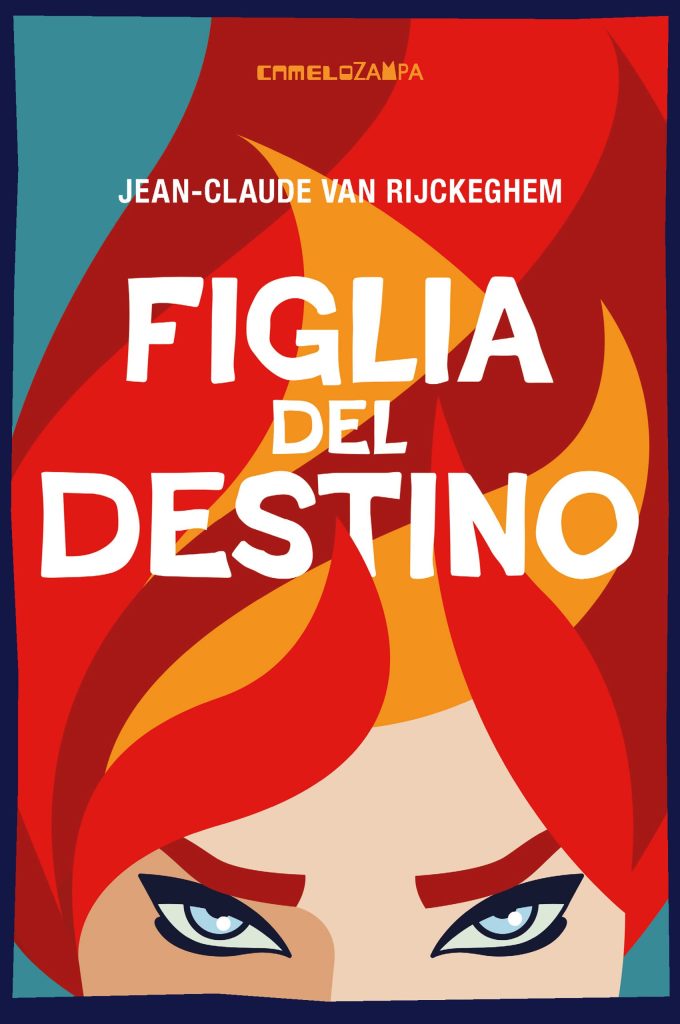
The novel has also been published in Italy as ‘Figlia del destino’ (Daughter of Destiny).
 Jean-Claude Van Rijckeghem